
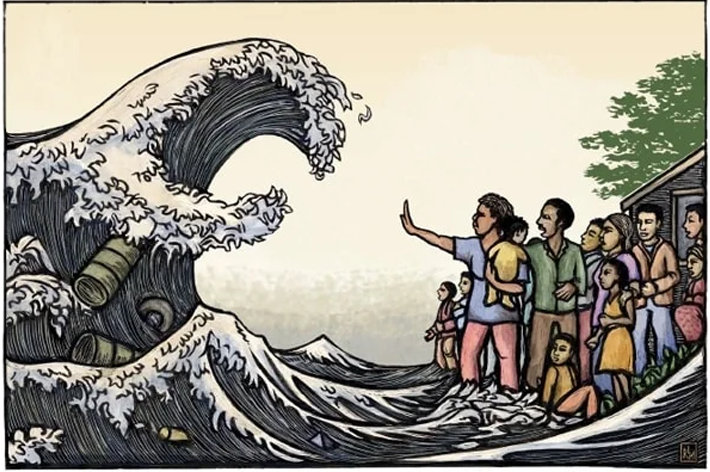
Campaigning for Change
The Government of Canada “launched consultation and engagement activities with Canadians on the right to a healthy environment in the Canadian Environmental Protection Act, 1999 (CEPA)”2. Two Bills outline the strategies to investigate and create solutions but, there is no mention of the tragedies, furthering misunderstandings.
Attawapiskat’s journey with Canada has “broken treaty promises, discriminatory acts and policies aimed at assimilation, and the appropriation of land and resources to the exclusion of Indigenous peoples” 3. The consequences are “serious physical, emotional, psychological, and spiritual health effects”, which we saw as seven children were brought into hospitals with possible drug overdoses from suspected suicide attempts4.
In the documentary After the Last River, filmmaker Victoria Lean highlights the black mold growth, de-watering the wetlands and increasing mercury, while dealing with a Diesel spill under their school. “Kids never complain, they just accept what they have. They think it’s a normal way of life. But when they go off reserve, and they see opportunities, It’s an eye-opener for them. They ask how come I don’t have this back home? Why is it different?
Then they are at the stage they realize it’s because of discrimination.
And when they have that feeling, it does something to you, in your body, and your self-esteem. “I shouldn’t be treated like this” and that’s when all this frustration comes out. Just to know that you are treated different.” —Theresa Spence 6.
The government does not address this within the claim to a “right to a healthy environment and environmental justice and racism”. Examples like “Nova Scotia include an open dump in Africville, landfills in Shelburne and Lincolnville, a pulp and paper mill in Pictou Landing First Nation, and a pipeline in Sipekne’katik First Nation. A pipeline also runs through Wet’suwet’en First Nation in British Columbia, while in Ontario there is mercury contamination in Grassy Narrows First Nation and over 60 petrochemical facilities surrounding Aamjiwnaang First Nation.”7. “Ultimately, the first step…will be an open and honest examination of the links between race, socio-economic status, and environmental risk in Canada”8 because there are still frequent water advisories to extensive Indigenous communities9.
- Stewards of the land and Wildlife.(n.d.) Destination Indigenous. Retrieved April 29, 2024. https://destinationindigenous.ca/nature-and-wildlife/stewards/#:~:text=Historically%2C%20we%20have%20been%20stewards,and%20all%20of%20its%20creatures.
- Canada taking next steps on the right to a healthy environment and environmental justice and racism. (2024, Feb 08). Government of Canada, Retrieved April 29, 2024. https://www.canada.ca/en/environment-climate-change/news/2024/02/canada-taking-next-steps-on-the-right-to-a-healthy-environment-and-environmental-justice-and-racism.html
- Environmental racism in Canada. (2022, Aug) PubMed Central. Retrieved on April 29, 2024 https://www.ncbi.nlm.nih.gov/pmc/articles/PMC9374073/
- Spurr, B. (2016, April 18) How the Attawapiskat suicide crisis unfolded. Toronto Star. https://www.thestar.com/news/canada/how-the-attawapiskat-suicide-crisis-unfolded/article_76724b6a-3d49-56ad-ad17-9531459a89d8.html
- Attawapiskat First Nation versus De Beers Diamond Mine. (2020, October 2) Socialist Project. Retrieved on April 29, 2024. https://socialistproject.ca/2020/10/attawapiskat-first-nation-vs-debeers-diamond-mine/
- Lean, V. (Director). (2015). After the Last River [film]. Tubi. https://tubitv.com/movies/691519/after-the-last-river
- Waldron, I. (2020, Dec, 24) Environmental Racism in Canada. The Canadian Encyclopedia. https://www.thecanadianencyclopedia.ca/en/article/environmental-racism-in-canada
- Mitchell, K. D’Onofrio, Z. (2016) Environmental Injustice and Racism in Canada: The First Step is Admitting We Have a Problem. Journal of Environmental Law and Practice, Vol. 29, 305-345. https://www.proquest.com/docview/1771698573?parentSessionId=zpkXA0oSxDvp5XdFgE8xBMfBwZdctR59OO%2BEDLbaGnw%3D&pq-origsite=summon&accountid=13631&sourcetype=Scholarly%
- Hock, J. (2021, May). Water Walk: A Research-Driven Guide to Clean Water in Indigenous Communities. University of British Colombia. https://open.library.ubc.ca/soa/cIRcle/collections/graduateresearch/42591/items/1.0397283
Leave a Reply